

In an effort to have the healthiest pregnancy and baby possible, most women begin taking prenatal vitamins early, often even before conception. However, what many don’t realise is that some prenatal vitamins can actually make morning sickness worse.
Is that even possible? Yes, absolutely.
Certain nutrients and ingredients commonly found in prenatal multivitamins can trigger nausea, particularly during the first trimester when morning sickness is most prevalent.
Let’s explore which ingredients may be contributing to nausea, and how to make your prenatal routine more comfortable.
How Prenatal Vitamins Can Affect Morning Sickness
Morning sickness typically begins in the early weeks of pregnancy and can range from mild nausea to severe vomiting. While many women seek natural morning sickness relief, some nutrients in prenatal formulas can worsen symptoms if taken in the wrong amounts or at the wrong time.
Vitamin B6 is known to reduce nausea in many women, but others particularly those sensitive to iron, iodine, zinc, or vitamin B12 may experience increased discomfort.
Iron
Studies show that iron supplementation during the first trimester can aggravate symptoms of morning sickness.
Iron requirements increase significantly in the second half of pregnancy, but in the early stages, your needs are often still being met from dietary stores built up before conception. This creates a dilemma for many women, iron is essential, but it can also trigger nausea when taken too early or in high doses.
If you’re in your first trimester, focus on increasing dietary sources of iron instead. Foods such as lean meats, seafood, legumes, dark leafy greens and dried apricots are excellent options.
For those who are iron-deficient or can’t meet their needs through food alone, a gentle iron supplement such as NaturoBest’s Iron & Brain Support may help. This formula is easy on the stomach and can be taken a few times per week if tolerated.
Zinc
Zinc is one of the most important minerals for preconception, pregnancy, and postpartum health. However, it’s also known to cause nausea in some people, whether they’re pregnant or not.
The recommended daily intake (RDI) for zinc during pregnancy is 11 mg, and this amount is generally well tolerated by most women. If higher doses are needed, consider taking zinc with food or at night to reduce nausea.
Iodine
Iodine plays a crucial role in thyroid function and foetal brain development. However, it can also influence morning sickness.
The pregnancy hormone human chorionic gonadotropin (hCG) naturally stimulates the thyroid during the first trimester, unfortunately this stimulation can also aggravate nausea. The embryo uses hCG to increase iodine availability, prioritising its own development, which can temporarily deplete the mother’s iodine and worsen symptoms if intake is unbalanced.
Interestingly, research suggests that when iodine intake is adequate, morning sickness tends to be mild to moderate, while severe or absent nausea may signal thyroid imbalance such as hypothyroidism. This is something your healthcare professional can check with a simple blood test.
Many prenatal vitamins contain 270 mcg of iodine, which is suitable for breastfeeding and trimester two and three, but higher than what’s needed during earlier stages of pregnancy. Typical prenatal vitamins have been designed for the entire preconception, prenatal and postnatal period. The RDI for iodine in pregnancy is 220 mcg, with a minimum recommended supplement dose of 150 mcg.
B Vitamins
High doses of certain B vitamins can cause nausea in some women, while others such as vitamin B6, have been clinically shown to reduce it.
Research demonstrates that 75 mg of vitamin B6 combined with 1,300 mg of ginger per day can significantly reduce the frequency and severity of morning sickness.
Vitamin B12 may also provide relief for some women, though responses can vary.
It’s essential to take at least 500 mcg of folate (as folic acid or active folate) in the month prior to conception and during the first six weeks of pregnancy, when the neural tube is forming and closing.
Choosing the Right Prenatal Vitamin
Nutrient needs change significantly throughout preconception and pregnancy. Taking the same prenatal supplement from preconception through all three trimesters may not always be ideal. For many women, a trimester-specific formula can provide more targeted support and reduce nausea in early pregnancy.
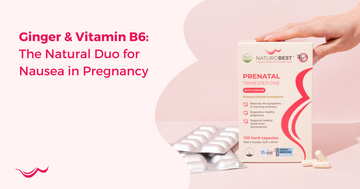
NaturoBest’s Prenatal Trimester One with Ginger has been specially formulated for the first trimester. It includes 75 mg of vitamin B6 and 1,300 mg of ginger to help ease morning sickness while supplying essential nutrients for early foetal development, including 500 mcg of Quatrefolic®, a premium bioavailable form of folate.
Once you move beyond the first trimester, your nutritional needs change again. NaturoBest’s Prenatal Trimester 2 & 3 Plus Breastfeeding is designed to provide comprehensive support for the later stages of pregnancy and beyond. It contains higher levels of iron to meet the increased demands of blood volume expansion, along with key nutrients such as choline, iodine, and activated B vitamins to support energy, healthy thyroid function, and continued foetal development. Together, these trimester-specific formulas work in synergy, Trimester One with Ginger for nausea relief and early pregnancy support, followed by Trimester 2 & 3 Plus Breastfeeding for sustained nourishment throughout pregnancy and the postnatal period.
The Takeaway
If your prenatal vitamin is making you feel worse instead of better, you’re not alone.
Simple adjustments such as switching to a gentler formula, timing your supplements differently, or ensuring nutrients match your stage of pregnancy can make a huge difference.
Your body is doing incredible work right now, and the right prenatal support can help you feel your best while giving your baby the nutrients they need to thrive.